
CISM Domain 4 - Incident Handling MindMap
Download FREE Audio Files and Printable PDFs of our MindMaps
Your information will remain 100% private. Unsubscribe with 1 click.
Transcript
Introduction
Hey, I’m Nick from Destination Certification, and I’m here to help YOU pass the CISM exam.
In this video, we’re going to break down a full MindMap of some of the most important concepts in Incident Handling from Domain 4— not just to help you memorize terms, but to really understand how they interconnect and why they matter.
This is the fourth of six videos for domain 4. I have included links to the other MindMap videos in the description below. These MindMaps are one part of our complete CISM MasterClass.
If you were watching Domain 3 in order, thank you for your patience and attention in going through this massive domain!
Managing, resolving, and learning from security incidents
So, today we’ll be reviewing some of the main themes related to incident handling. Incident handling represents your organization's systematic approach to managing security breaches when they occur.
Every security incident presents three distinct opportunities for your organization. Management involves coordinating resources and maintaining control during the crisis. Resolution focuses on eliminating the threat and restoring normal operations. Learning transforms each incident into valuable intelligence that strengthens your future defenses, creating a continuous improvement cycle that makes your organization more resilient with each challenge faced.
In a way, an organization has to a bit of all of these activities when handling an incident and, more importantly, ensuring it has taken the necessary steps to prevent it from happening again.
Incident Communication
This may not seem intuitive, but communicating during and after an incident in a systematic and effective approach is very much essential. Now, why is that exactly? Here is a simple example:
When an incident strikes, your first priority becomes preventing its spread while simultaneously alerting the right stakeholders. Proper communication ensures that technical teams, management, and external parties receive timely, accurate information needed for their respective roles in the response effort.
Incident Containment Methods and Response Communication
When an incident strikes, your first priority becomes preventing its spread while simultaneously alerting the right stakeholders. Containment stops the bleeding by isolating affected systems before damage spreads across your network. Meanwhile, proper communication ensures that technical teams, management, and external parties receive timely, accurate information needed for their respective roles in the response effort.
So one of the things we have to keep in mind is notification requirements.
Notification Requirements

Notification requirements define who must be informed during an incident, ensuring proper escalation and compliance with legal obligations.
A lot of stakeholders need to be involved, but usually with different levels of intensity, so let’s review some of them. We can start with external vendors.
External vendors
External vendors include third-party security firms, forensics specialists, or managed service providers who assist with incident response.
Offsite facility contacts
Next up, offsite facility contacts become critical when incidents affect primary locations. These include disaster recovery sites, backup data centers, and alternate work locations that enable business continuity during major incidents.
Law enforcement
Another stakeholder that needs to be contacted in certain scenarios is law enforcement.
Law enforcement agencies must be contacted for criminal activities like data theft, ransomware attacks, or suspected nation-state intrusions.
Legal team
Someone whose help you may need is your legal team.
Your legal team provides guidance on regulatory compliance, breach notifications, and potential litigation arising from security incidents.
Regulatory bodies
Finally, regulatory bodies such as HIPAA enforcement must receive breach notifications within specific timeframes defined by law.
Now that we’ve resolved who needs to be notified, let’s talk about incident eradication and recovery.
Incident Eradication and Recovery
After containing an incident, you must completely remove the threat from your environment and restore normal operations. Eradication eliminates all traces of the attacker's presence, including backdoors, malware, and compromised accounts. Recovery then rebuilds affected systems from clean backups, validates their integrity, and carefully returns them to production while monitoring for any signs of persistent compromise.
An important question is where do you even start after an indecent? As good as place as any is with eradication activities.
Eradication activities
Eradication activities remove all malicious artifacts, including malware, unauthorized accounts, and backdoors left by attackers. We can start diving into these by considering root cause analysis.
Root cause analysis
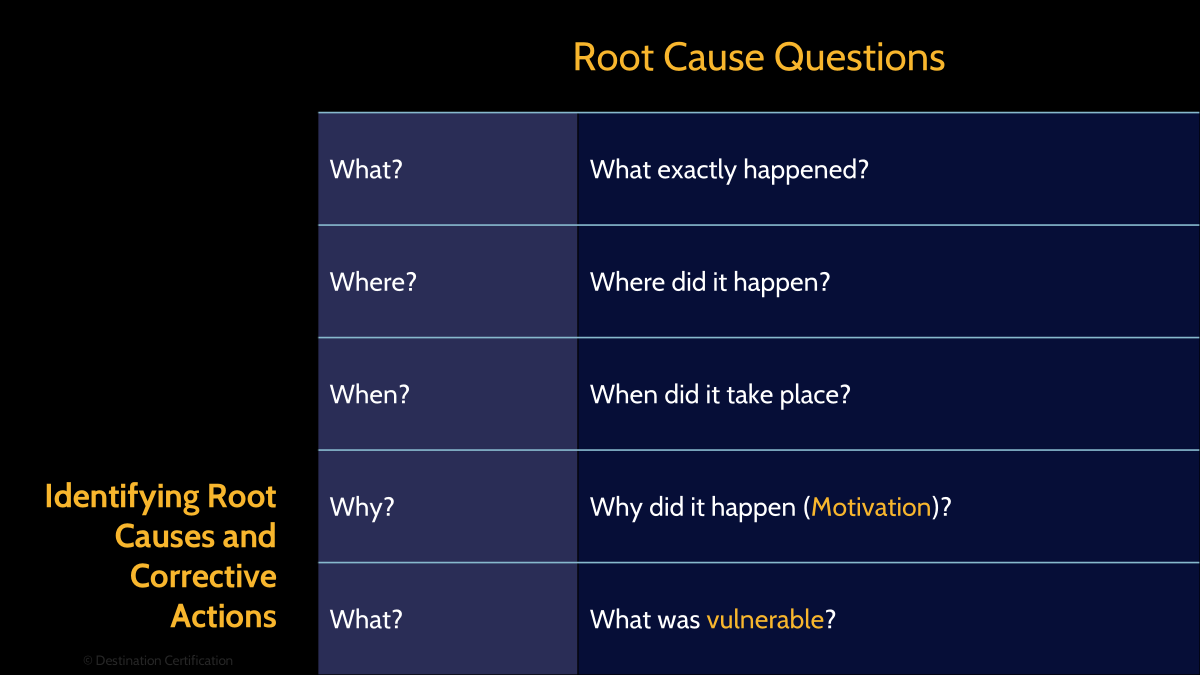
Root cause analysis digs beneath surface symptoms to uncover fundamental security failures that enabled the incident. This systematic investigation examines technical vulnerabilities, process breakdowns, and human factors that converged to create the breach opportunity. Incidents are like leaks: patching the drip is easy, but finding out why the pipe burst keeps the rest of the house from flooding. The insights gained from thorough root cause analysis drive strategic security improvements that prevent entire categories of future incidents rather than just patching individual vulnerabilities.
System wipe
Next up, a system wipe completely erases and rebuilds compromised systems to ensure no malicious code or configurations remain.
Account removal
Our next eradication activity is account removal. Account removal eliminates unauthorized user accounts, service accounts, and administrative privileges created by attackers.
Policy update
Finally, policy updates transform lessons learned into formal security improvements. After identifying how attackers exploited gaps in your defenses, you revise security policies, access controls, and operational procedures to close those vulnerabilities. These updates might strengthen password requirements, restrict administrative privileges, or mandate additional monitoring for critical systems, ensuring the organization doesn't repeat the same mistakes.
Now that we’ve wrapped up policy updates, we can begin discussing recovery activities.
Recovery activities
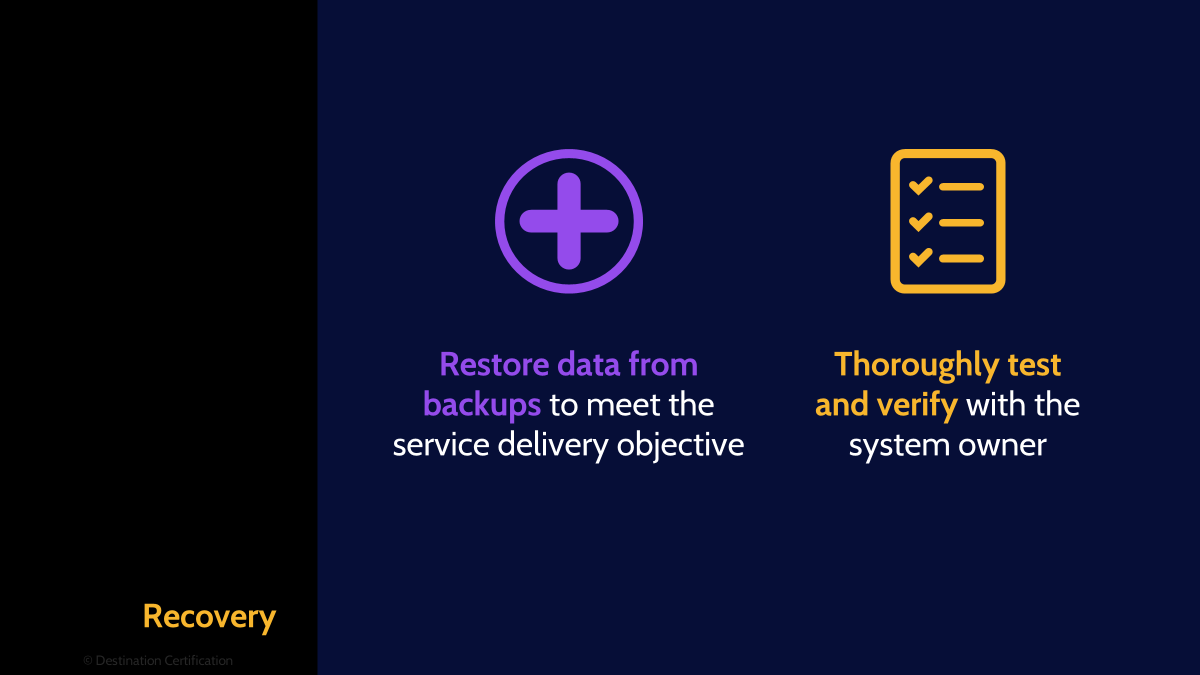
Recovery activities restore normal business operations by rebuilding systems, restoring data, and verifying functionality. One example is validation.
Validation
Validation confirms that recovered systems function correctly and contain no residual malware or unauthorized modifications.
Monitoring
Next up, enhanced monitoring watches recovered systems closely for signs of reinfection or persistent attacker presence.
Searching
Searching involves scanning the entire environment for additional compromised systems or indicators of compromise.
Moving
Another recovery activity is moving. Moving critical data and services to secure, uncompromised systems ensures business continuity during recovery. By relocating workloads, organizations can restore business operations faster, minimize downtime, and reduce the risk of reinfection. This step often leverages backups, redundant systems, or cloud infrastructure to keep essential functions running while the affected environment is rebuilt or cleaned
Remediation
Last but not least, remediation applies patches, configuration changes, and security updates to prevent similar incidents from recurring.
Now that we’ve eradicated and recovered, we can begin thinking about post-incident review.
Post-Incident Review Practices
Post-incident review transforms crisis experience into organizational wisdom. It’s like watching the game tape after a match: celebrate the highlights, cringe at the fumbles, and plan how to play smarter next round.Through honest assessment and documentation, your team builds institutional knowledge that strengthens future incident response capabilities while satisfying compliance requirements for incident reporting and evidence preservation.
Post Incident Activities
Post incident activities capture lessons learned and fulfill administrative requirements. These include documenting the incident timeline, creating reports for stakeholders, and preserving evidence for potential legal proceedings or compliance audits. There are some important steps here, starting with documentation.
Incident documentation
Incident documentation creates a permanent record of the attack timeline, response actions, and decisions made during the incident.
Report creation
Secondly, report creation produces executive summaries, technical analyses, and compliance reports tailored to different stakeholder needs.
Request budget for remediation work
Finally, requesting a budget for remediation work leverages incident impact to justify security investments. You document costs incurred, risks exposed, and resources needed to prevent recurrence, building a compelling business case for security improvements.
While all of these are very important, it’s also significant to keep in mind the evidence investigators may need.
Evidence
Evidence consists of digital artifacts, logs, and forensic data collected during incident investigation and response.
Chain of custody
The first element relevant here is a chain of custody documents who handled evidence, when they accessed it, and what actions they performed. This unbroken record ensures evidence remains admissible in legal proceedings by proving it hasn't been tampered with or altered.
Evidence preservation
Next up, evidence preservation maintains forensic integrity through proper storage, hashing, and access controls on collected digital evidence.
One last thing for us to consider today is investigation types.
Investigation Types
Not every investigation plays by the same rules — a criminal case isn’t handled the same way as an internal policy slip-up. Each type has its own playbook for evidence handling and reporting.
Let’s walk through the main categories, starting with criminal investigations.
Criminal
Criminal investigations involve law enforcement and focus on prosecuting attackers for computer crimes and data theft.
Civil
Next, civil investigations prepare for potential lawsuits from affected customers, partners, or shareholders seeking damages.
Regulatory
Moving on, regulatory investigations put your organization under the microscope to prove you’re following data protection laws and industry security standards. Think of it as a surprise pop quiz from the regulators — except failing it can cost a lot more than just a bad grade.
Industry standards
Slightly differently in terms of how they are conducted are industry standards investigations.
Industry standards investigations verify adherence to frameworks like ISO 27001, NIST, or sector-specific security guidelines.
Administrative
Finally, administrative investigations address internal policy violations, employee misconduct, or unauthorized system access by insiders.

And that is an overview of Incident Handling within Domain 4, covering the most critical concepts you need to know for the exam.
Something really cool we are providing with these MindMap videos is a completely FREE downloadable version of all the MindMaps in PDF format. We even include a blank version of each MindMap in case you want to print them out and take notes as you listen along. Link to download the MindMaps is in the description below.
If you found this video helpful you can hit the thumbs up button and if you want to be notified when we release additional videos in this MindMap series, then please subscribe and hit the bell icon to get notifications.
I will provide links to the other MindMap videos in the description below.
Thanks very much for watching! And all the best in your studies