
CISM Domain 4 - Incident Management Response Plans MindMap
Download FREE Audio Files and Printable PDFs of our MindMaps
Your information will remain 100% private. Unsubscribe with 1 click.
Transcript
Introduction
Hey, I’m Nick from Destination Certification, and I’m here to help YOU pass the CISM exam.
In this video, we’re going to break down a full MindMap of some of the most important concepts in Incident Management Response Plans from Domain 4— not just to help you memorize terms, but to really understand how they interconnect and why they matter.
This is the second of six videos for domain 4. I have included links to the other MindMap videos in the description below. These MindMaps are one part of our complete CISM MasterClass.
Incident Management Objectives
Incident Management Response Plans form the backbone of organizational resilience in today's threat landscape. What exactly is their main purpose or objective? How do they work? These are some of the main questions we’ll be unpacking today.
The primary objectives of incident management center on protecting organizational assets while maintaining business continuity. They do so first by containing and minimizing damage.
Contain and minimize damage
Containment strategies focus on preventing an incident from spreading throughout the infrastructure while minimizing operational disruption. Containment is all about speed: isolate the problem, block the bad stuff, and cage the threat before it spreads — just don’t rush so fast you torch the evidence or crash the business in the process. Once the immediate threat is contained, the next step is figuring out what really caused it. That’s where root cause analysis comes in — digging deeper than symptoms to uncover the vulnerabilities that opened the door.
Determine root cause
Root cause analysis goes beyond addressing symptoms to identify the fundamental vulnerabilities that enabled the incident. This investigative process examines technical failures, process gaps, and human factors that contributed to the breach. By uncovering the real vulnerabilities, root cause analysis helps prevent repeat incidents. But successful incident management doesn’t stop there — its outcomes go well beyond resolving the immediate threat.
Incident Management Outcomes
So, next, we need to talk about the main incident response outcomes.
Rapid incident detection
The first outcome is rapid incident detection.
Detection speed directly impacts the severity of security incidents, with faster identification limiting attacker dwell time and reducing potential damage.
Risk mitigation
The second outcome is risk mitigation.
Risk mitigation during incidents involves implementing controls that reduce the likelihood and impact of similar future events.
Maintain compliance
The third, but no less important, outcome is maintaining compliance. Compliance maintenance during incidents requires careful documentation, timely notifications, and adherence to regulatory requirements even under pressure. Proper compliance handling prevents regulatory penalties that often exceed the direct costs of the incident itself.
At the end of the day, it all comes back to incident response — because no matter how good your compliance looks on paper, it’s how you handle the chaos that really counts.
Incident Response
So, what is our ultimate goal here? If you’re wondering a lot about that, I’ll just say that you may want to take a look at our previous MindMap for Domain 4, but we can quickly recap that the main goal is to limit damage, reduce recovery time and costs, and protect organizational assets.
Defining an incident response plan
Next, we should review the main elements of the incident response plan, starting with preparation. This is really a strategic playbook so that everyone on the team knows how to handle these events and, like many other elements, it all starts with a solid foundation (preparation, to be more exact). So what do we do in that particular step?
Preparation
Preparation establishes tools, procedures, and team readiness before incidents occur through training, documentation, and resource allocation.
Identification
Secondly, identification involves detecting and confirming security incidents through monitoring, alerts, and analysis of suspicious activities.
Containment
Moving on, containment strategies prevent incident spread through network isolation, access restrictions, and system quarantine.
Eradication
Furthermore, eradication removes all traces of the threat including malware, compromised accounts, and attacker-created backdoors from affected systems.
Recovery
Next up in the incident response plan is recovery that restores systems to normal operations through careful restoration, monitoring, and validation processes.
Lessons Learned
Finally, you can’t spell ‘experience’ without ‘incident’… okay, maybe you can, but you get the point: lessons learned sessions turn mistakes into improvements. Lessons learned sessions analyze incident response effectiveness to identify improvements for future incidents and update response procedures.
Now that we have reviewed all of the components, we should consider the Security Incident Response Plan.
SIRP (Security Incident Response Plan)
The Security Incident Response Plan serves as the authoritative document governing how organizations handle security incidents from detection through resolution. This comprehensive framework integrates technical procedures with business considerations, ensuring response activities align with organizational risk tolerance and regulatory obligations. To do so effectively, we need senior management sign-off.
Senior management sign-off
Executive approval of the SIRP demonstrates organizational commitment and ensures adequate resources for incident response.
Capabilities
Secondly, the organization needs capabilities - these outline the technical and operational functions the incident response team can perform during security events. Another thing we always need to be mindful of is ensuring proper incident notification - which is the next piece we will be reviewing today.
Incident Notification
Incident notification protocols ensure timely communication to stakeholders, regulators, and affected parties according to legal and contractual obligations. There’s more to this and we’ll be reviewing notification requirements in more depth in a MindMap in video 4 of this domain. I hope you can wait a bit longer for that and still have some interest for incident management and response teams - the next topic we’re covering today.
Incident Management and Response Teams
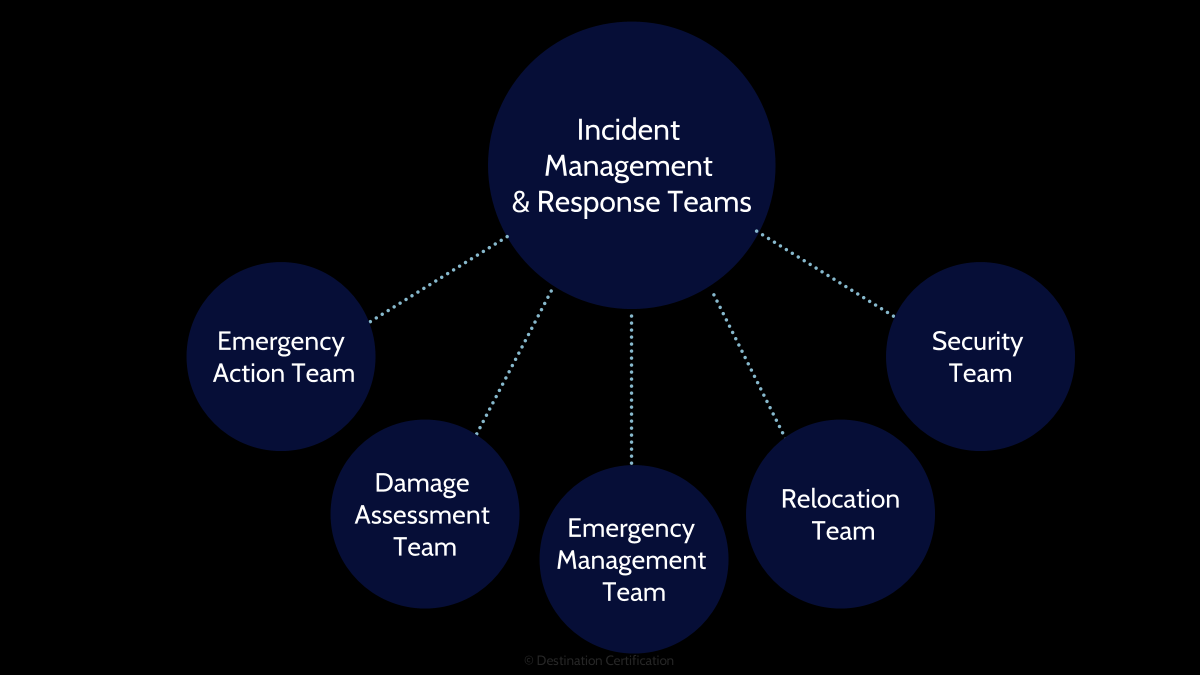
Specialized response teams bring together diverse expertise required for comprehensive incident management, from technical analysis to business continuity. These teams operate under defined structures that clarify responsibilities, communication channels, and decision-making authority during high-pressure situations. One such team is the Emergency Action Team (also known as the EAT).
Emergency Action Team (EAT)
The EAT provides immediate response to critical incidents, making rapid decisions to protect life and critical assets. This team operates with pre-authorized powers to take extraordinary measures during crisis situations, including facility evacuation, system shutdown, and emergency communications. Their actions during the first hours of an incident often determine overall impact severity.
Damage Assessment Team (DAT)
A second vital team is the Damage Assessment Team that evaluates incident impact across technical, operational, and financial dimensions to inform recovery priorities. Their analysis determines resource allocation, insurance claims, and regulatory reporting requirements. Accurate damage assessment enables organizations to make informed decisions about recovery investments and communicate realistic timelines to stakeholders.
Emergency Management Team (EMT)
Next off, the Emergency Management Team coordinates overall crisis response, integrating technical incident response with business continuity efforts. This team manages stakeholder communications, resource allocation, and strategic decisions that balance security needs with business requirements. Their leadership during major incidents maintains organizational stability while technical teams focus on threat remediation.
Relocation Team
Another important component is the Relocation Team. It manages the complex logistics of moving operations to alternate facilities during incidents that compromise primary locations. While their name may make it sounds like they will be planning your next holiday, that’s not the best way to think about their role. It’s like planning a surprise office field trip — alternate sites ready, transportation arranged, comms sorted — except this trip keeps the business running when disaster shows up.
Security Team
To round up the main teams, the Security Team provides specialized expertise in threat analysis, forensics, and technical remediation during security incidents. These professionals understand attacker techniques, security tools, and defensive strategies necessary for effective incident response. Their technical skills combined with incident experience enable rapid threat neutralization while preserving evidence for investigation.
Even with solid plans and relocation strategies, incidents won’t run themselves — people will. That’s why clearly defined roles are essential to ensure nothing is missed or duplicated.
Roles
Clearly defined roles ensure comprehensive incident coverage without duplication or gaps in responsibility. Each role brings specific expertise and authority necessary for different aspects of incident response, from technical analysis to stakeholder communication. Let’s just cover some of the most prominent roles, starting with the incident response team lead.
Incident response team lead
The incident response team lead coordinates technical response activities, ensuring efficient resource utilization and consistent procedures. This role requires both technical expertise and leadership skills to manage diverse team members during high-pressure situations. Effective team leads maintain operational tempo while preventing team burnout during extended incidents. Sounds like a simple and easy job everyone wants, right? Well, here’s another, the lead investigator.
Lead investigator
The lead investigator directs forensic analysis and evidence collection to determine incident cause, scope, and attribution. This role requires deep technical expertise in digital forensics, malware analysis, and investigative techniques. Their findings inform both immediate response actions and long-term security improvements while supporting potential legal proceedings.
Think of roles as the players — now it’s time to decide on the formation. Team structures determine whether you play with a tight central squad, a spread-out defense, or a hybrid lineup
Incident Management Team Organization
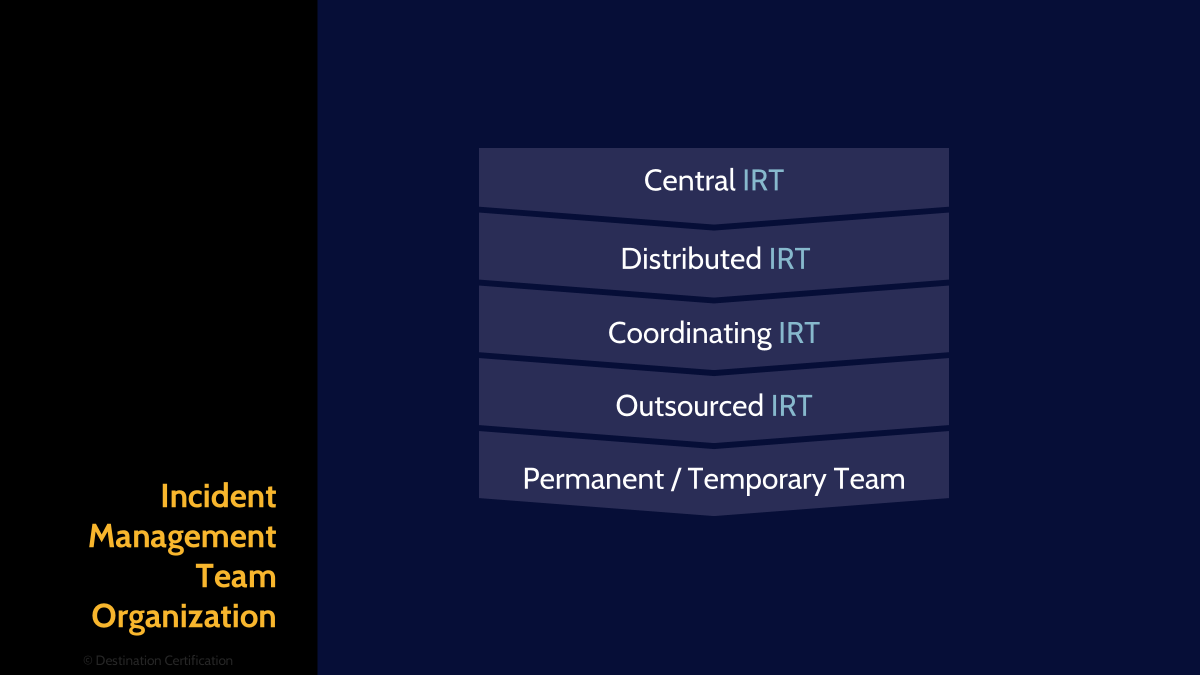
Team organizational structures determine how incident response capabilities are deployed across the enterprise, balancing centralized expertise with distributed presence. The chosen model must align with organizational size, geographic distribution, and risk profile while maintaining consistent response quality. Different structures offer varying trade-offs between response speed, cost efficiency, and local knowledge. The first structure we’lll be reviewing is that of central indecent response teams (or IRT for short).
Central IRT
Centralized IRT concentrate expertise in a single location, providing consistent, high-quality response across the entire organization. This model enables deep specialization and efficient resource utilization but may struggle with geographic distribution and time zone coverage. Central teams excel at maintaining standardized procedures and tools while building strong team cohesion through close collaboration.
Distributed IRT
Next, and quite differently, distributed teams place incident response capabilities throughout the organization, providing local presence and cultural understanding. This model enables rapid on-site response and 24/7 coverage through follow-the-sun operations. The challenge lies in maintaining consistent procedures and skill levels across distributed team members who may have limited interaction with peers.
Coordinating IRT
Furthermore, coordinating teams provide oversight and orchestration for multiple incident response groups within large organizations. This model balances local autonomy with enterprise consistency, enabling business units to maintain specialized response capabilities while ensuring coordination during enterprise-wide incidents. Success requires clear delineation of responsibilities and robust communication protocols between teams.
Outsourced IRT
Another approach is hiring or contracting outsourced IRT.
Outsourced incident response leverages external expertise for organizations lacking internal capabilities or requiring surge capacity. This model provides access to specialized skills and 24/7 coverage without maintaining full-time staff. Organizations must carefully manage service provider relationships, ensuring rapid response while maintaining confidentiality and preserving internal knowledge of critical systems.
Permanent team
Outsourcing is not for every organization, so some find it preferable to have a permanent team.
Permanent teams consist of dedicated professionals whose primary responsibility is incident response, enabling deep expertise development and consistent availability. These teams justify their cost through reduced incident impact and faster resolution times. Permanent teams develop institutional knowledge and refined procedures that significantly improve response effectiveness over time.
Temporary team
On the other hand, temporary teams assemble on-demand from staff with other primary responsibilities, providing surge capacity during major incidents. This model reduces costs but requires careful planning to ensure availability and skill maintenance. Organizations using temporary teams must invest in regular training and clear activation procedures to maintain response readiness.
With that in mind, let’s escalate our way to the final topic of the day. I’m not sure that segway really worked, but we’ll still be talking about the escalation process.
Escalation criteria
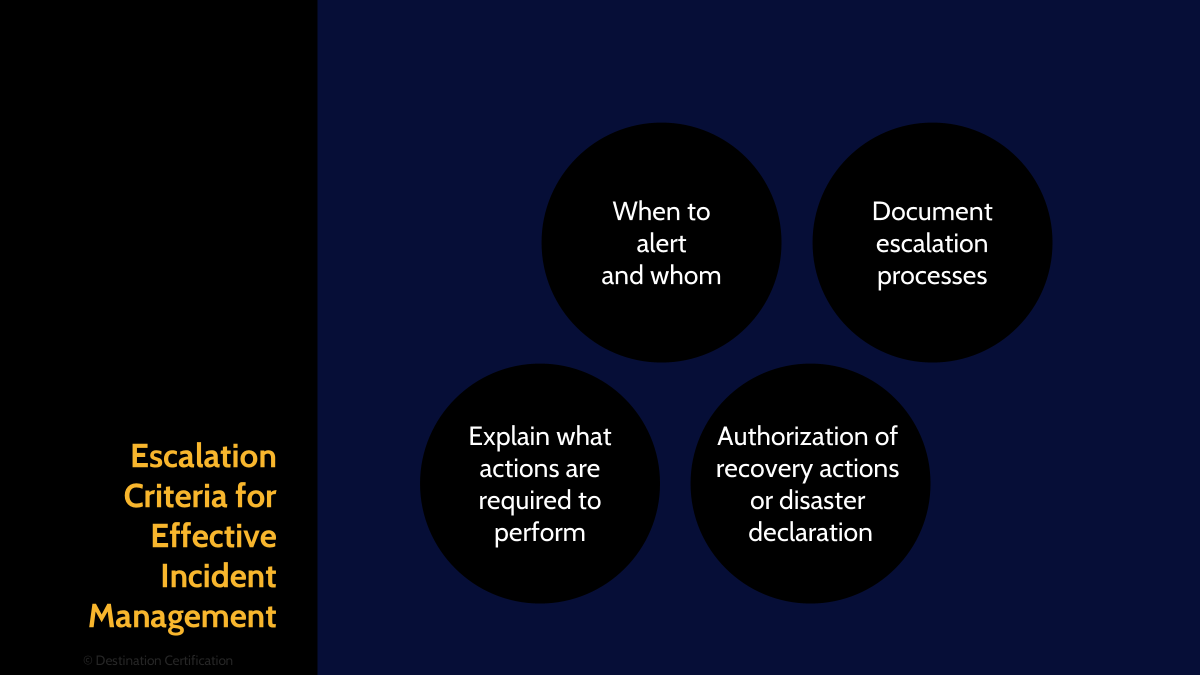
Escalation processes transform routine incidents into coordinated organizational responses when severity exceeds initial response capabilities. Now what exactly are the criteria to escalate an issue?
Escalation criteria define clear thresholds that trigger increased response levels, ensuring appropriate resources are engaged based on incident severity and impact. These predetermined triggers remove subjective decision-making during crisis situations, enabling rapid mobilization of specialized resources when needed. Well-designed escalation criteria balance the need for senior involvement in critical decisions with the importance of empowering front-line responders to act quickly.
Let us consider some of the main questions, starting with when to alert.
When to alert
Timing of alerts requires careful balance between gathering sufficient information and ensuring rapid response to critical threats. Premature escalation wastes resources and causes alert fatigue, while delayed notification allows incidents to escalate unnecessarily. Organizations must define clear triggers based on technical indicators, business impact, and regulatory requirements that guide consistent alerting decisions.
Secondly, we need to think about who must be alerted.
Who to alert
Alert recipients must be carefully selected based on incident type, severity, and required expertise to ensure effective response without overwhelming communication channels. Different audiences need different updates — tech teams want the play-by-play right away, while executive-level stakeholders just need the big picture. Smart alert routing keeps everyone informed without causing gaps or panic.
Next, we should think about documenting the escalation path and making it more of a clear process and less a set of ad-hoc actions.
Document escalation path and process
Documentation of escalation paths ensures consistent, reliable communication during incidents when normal channels may be compromised or unavailable. These documents must include primary and alternate contact methods, decision authorities, and time-based escalation triggers. Regular updates and testing verify that escalation procedures remain functional as personnel and systems change over time.
Recovery actions need to be authorized
Finally, to ensure accountability and avoid disastrous mistakes, authorization requirements for recovery actions ensure that system restoration follows proper procedures and doesn't inadvertently reintroduce vulnerabilities or compromise evidence. Clear authorization chains prevent premature recovery that could enable attackers to regain access while protecting teams from liability for business disruption caused by extended downtime necessary for thorough remediation.

And that is an overview of Incident Management Response Plans within Domain 4, covering the most critical concepts you need to know for the exam.
Something really cool we are providing with these MindMap videos is a completely FREE downloadable version of all the MindMaps in PDF format. We even include a blank version of each MindMap in case you want to print them out and take notes as you listen along. Link to download the MindMaps is in the description below.
If you found this video helpful you can hit the thumbs up button and if you want to be notified when we release additional videos in this MindMap series, then please subscribe and hit the bell icon to get notifications.
I will provide links to the other MindMap videos in the description below.
Thanks very much for watching! And all the best in your studies