
CISM Domain 3 - Information Asset Identification and Classification MindMap
Download FREE Audio Files and Printable PDFs of our MindMaps
Your information will remain 100% private. Unsubscribe with 1 click.
Transcript
Introduction
Hey, I’m Nick from Destination Certification, and I’m here to help YOU pass the CISM exam.
In this video, we’re going to break down a full MindMap of some of the most important concepts in Information Asset Identification and Classification from Domain 3— not just to help you memorize terms, but to really understand how they interconnect and why they matter.
This is the third of thirteen videos for domain 3. I have included links to the other MindMap videos in the description below. These MindMaps are one part of our complete CISM MasterClass.
Perform identification and ownership
To step back up a bit, let’s first clear up a few things: Information asset identification and classification forms the foundation of any robust security program. Organizations today manage vast amounts of data across multiple platforms, from customer records to intellectual property, and without a systematic approach to identifying what you have and determining its value, you cannot protect it effectively. This process goes beyond simple cataloging - it requires understanding the business context of each asset, its lifecycle, regulatory requirements, and potential impact if compromised.
Performing identification and ownership represents the critical first step where organizations discover and document all information assets across their environment. This process requires collaboration between IT, business units, and data governance teams to ensure nothing falls through the cracks. You're not just creating a list - you're establishing accountability by assigning specific individuals or departments as owners who understand the asset's business value and can make informed decisions about its protection. Modern organizations often struggle with shadow IT and decentralized data creation, making this identification process an ongoing challenge that requires automated discovery tools combined with regular audits and stakeholder engagement.
Perform data classification
Data classification is our important second step. It transforms raw inventory into actionable security strategy by assigning sensitivity levels that drive protection decisions. Organizations typically implement multi-tiered systems ranging from public to highly confidential, with each level triggering specific handling requirements. The challenge lies in creating classifications that are granular enough to be meaningful yet simple enough for users to understand and apply consistently. Successful classification programs balance regulatory requirements, business needs, and practical implementation considerations. They must account for data that changes classification over time, mixed-sensitivity documents, and the reality that overclassification can be as problematic as underclassification, leading to unnecessary costs and reduced productivity.
Classification Process
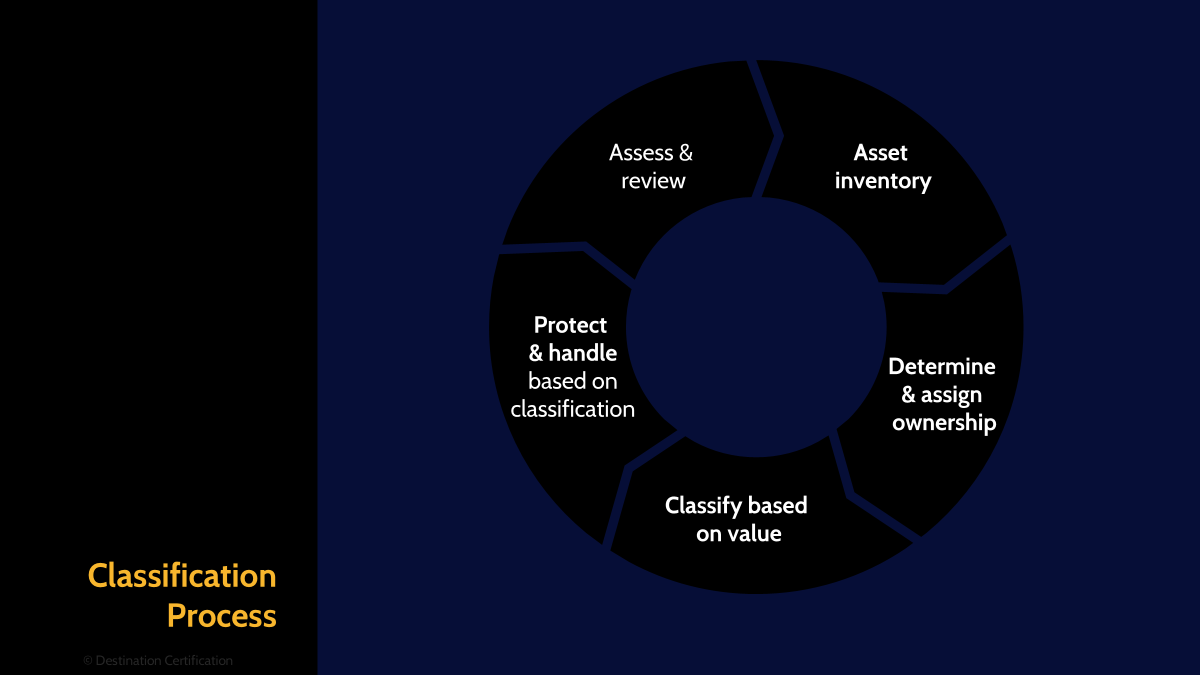
The classification process provides a structured methodology that ensures consistency and completeness across your entire data landscape. Rather than ad-hoc decisions, you follow a repeatable workflow that begins with discovery and ends with ongoing review. It’s like designing a dress code: clear enough to avoid fashion disasters, flexible enough for different occasions, and strict enough to pass inspection when the auditors come knocking.
Asset inventory
Our first step in classifying is asset inventory.
Asset inventory creates a comprehensive catalog of all information assets including databases, documents, applications, and data flows throughout the organization.
Determine and assign ownership
Next, we have to determine and assign ownership.
This involves identifying the business stakeholder responsible for each asset's security decisions and lifecycle management. For example, the HR director owns employee records while the CFO owns financial statements, ensuring accountability and informed risk decisions.
Classify based on value
Our next step is classifying based on value.
Classification by value isn’t just about the dollar signs; it looks at the full price tag, including fines from regulators, the edge you hold over competitors, and even the hit your reputation might take if things go wrong. For example, a customer database isn’t just rows of names and emails. It’s a treasure chest of personal data that regulators watch closely, hackers drool over, and customers expect you to guard like Fort Knox. That’s why it gets slapped with a ‘highly confidential’ label - because the cost of a breach is way more than just IT cleanup; it’s legal bills, lost trust, and headlines you don’t want to read.
Protect and handle based on classification

Now that we’ve classified the data, our next step is protecting it.
Protection measures scale with classification levels - public data requires minimal controls while top secret information demands encryption, access restrictions, and audit trails. Handling procedures specify how users must treat data during creation, transmission, storage, and disposal.
Assess and review
Our last step is constant assessing and reviewing to make sure the classification remains up-to-date.
Think of it like cleaning out a closet: regular audits and reviews make sure nothing sensitive is shoved in the wrong drawer, old stuff gets re-labeled, and gaps don’t sneak by while your business keeps changing. Organizations must balance the need for current classifications with the operational burden of constant reclassification, typically establishing annual reviews with trigger events for immediate updates.
Data Loss Prevention (DLP)

Think of classification as putting ‘Fragile’ stickers on boxes. DLP is the system that makes sure those boxes don’t get tossed off the truck.
Data Loss Prevention represents the technological enforcement arm of your classification program, using sophisticated tools to prevent unauthorized data exposure whether malicious or accidental. Modern DLP solutions integrate with classification systems to automatically apply protection based on data sensitivity, monitoring everything from email attachments to cloud uploads. The complexity lies in balancing security with usability - overly restrictive DLP policies frustrate users and encourage workarounds, while lenient policies fail to prevent breaches. Successful DLP implementation requires careful tuning, user education, and integration with incident response processes to handle violations appropriately.
This has several aspects to it, starting with discovery and classification.
Discovery & Classification
DLP discovery and classification capabilities scan your environment to find sensitive data wherever it resides, using pattern matching, regular expressions, and machine learning to identify credit cards, social security numbers, and proprietary information.
Enforcement
Next off, enforcement mechanisms translate classification policies into concrete actions, blocking unauthorized transfers, encrypting sensitive files, or quarantining suspicious activities. The enforcement engine must make split-second decisions about whether to allow, block, or redirect data flows based on content, context, and user identity.
Monitoring
Our next step in implementing DLP is monitoring.
Continuous monitoring provides visibility into data movement patterns, policy violations, and emerging risks across your environment. DLP monitoring generates detailed logs and analytics that feed into security operations centers, compliance reporting, and risk assessments. Beyond simple alerting, advanced monitoring correlates events to identify insider threats, detects data exfiltration attempts, and provides forensic evidence for incident investigation.
Architecture
Another important component to think of is DLP architecture.
It determines how and where data protection occurs, with each approach offering distinct advantages and limitations. The architectural decision impacts performance, scalability, and coverage completeness. Organizations often deploy hybrid architectures combining multiple approaches to achieve comprehensive protection. The main approaches are Network based, Client/Agent based and
Storage based.
Let us start by discussing Network-based DLPs.
Network based
Network-based DLP deploys at network egress points to inspect traffic leaving the organization, blocking sensitive data from unauthorized transmission via email, web, or file transfer.
Client/Agent based
Next, client-based DLP installs software agents on endpoints to monitor and control data usage at the source. These agents track file operations, clipboard activities, and application behavior, providing granular control even when devices operate outside the corporate network.
Storage based
As a third alternative, storage-based DLP scans data repositories including file servers, databases, and cloud storage to identify and protect sensitive information at rest through access controls and encryption.

And that is an overview of Information Asset Identification and Classification within Domain 3, covering the most critical concepts you need to know for the exam.
Something really cool we are providing with these MindMap videos is a completely FREE downloadable version of all the MindMaps in PDF format. We even include a blank version of each MindMap in case you want to print them out and take notes as you listen along. Link to download the MindMaps is in the description below.
If you found this video helpful you can hit the thumbs up button and if you want to be notified when we release additional videos in this MindMap series, then please subscribe and hit the bell icon to get notifications.
I will provide links to the other MindMap videos in the description below.
Thanks very much for watching! And all the best in your studies