
CISM Domain 3 - Information Security Awareness and Training
MindMap
Download FREE Audio Files and Printable PDFs of our MindMaps
Your information will remain 100% private. Unsubscribe with 1 click.
Transcript
Introduction
Hey, I’m Nick from Destination Certification, and I’m here to help YOU pass the CISM exam.
In this video, we’re going to break down a full MindMap of some of the most important concepts in Information Security Awareness and Training from Domain 3— not just to help you memorize terms, but to really understand how they interconnect and why they matter.
This is the twelfth of thirteen videos for domain 3. I have included links to the other MindMap videos in the description below. These MindMaps are one part of our complete CISM MasterClass.
Information Security Awareness and Training
You may be wondering – why so much awareness on people in security? Well, firewalls don’t click phishing links. People do. And that’s why awareness and training may be the most important security investments your organization can make.
Development of Training and Awareness Program
Developing an effective training and awareness program requires strategic planning that aligns security objectives with business goals and human psychology. The development process begins with a thorough risk assessment to identify the most critical threats facing your organization, followed by a skills gap analysis to understand current employee capabilities. Think of a strong security program like a workout plan: it mixes up the routines so nobody gets bored, balances training goals with the time you actually have, and builds strength step by step. And just like a trainer adjusts your plan after injuries or new challenges, these programs evolve with real incidents and emerging threats.
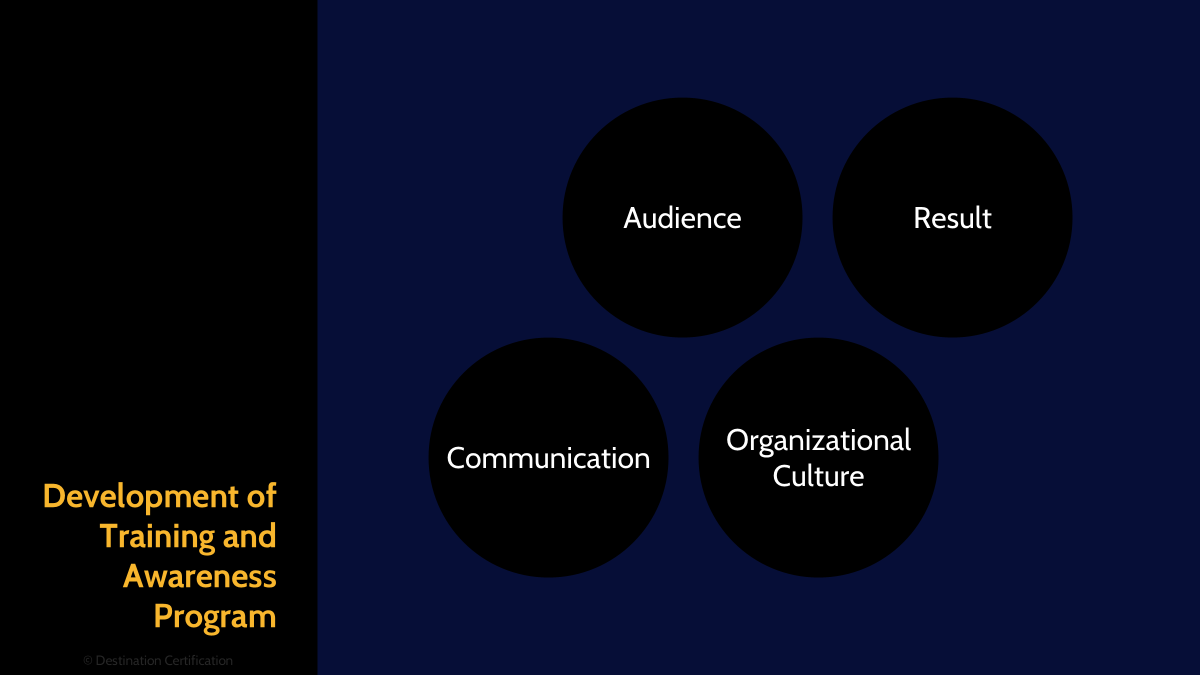
You should always consider your audience, result, communication and organizational culture when developing your training. So let’s discuss how your audience can impact training and awareness programs first.
Audience
Understanding your audience drives every aspect of program design, from content selection to delivery methods. Different roles within the organization face unique security challenges—executives handle sensitive strategic information, developers manage code repositories, and administrative staff process financial transactions. Each group requires tailored content that speaks to their specific responsibilities and risk exposure. Beyond role-based considerations, you must account for varying technical proficiency levels, cultural backgrounds, and generational differences in technology adoption.
Result
Next, defining and measuring results transforms security training from a compliance checkbox into a strategic business investment. Expected outcomes extend beyond simple knowledge transfer to include behavioral changes, incident reduction, and improved security culture metrics. Short-term results might include increased phishing email reporting rates and decreased password-related help desk tickets. Long-term results manifest as reduced breach frequency, faster incident response times, and proactive security suggestions from employees.
Communication
Furthermore, effective communication strategies determine whether security messages penetrate organizational consciousness or become background noise. Multi-channel approaches leverage email, intranet portals, digital signage, team meetings, and informal conversations to reinforce key messages. It’s like a fire drill: serious enough that everyone pays attention, but calm enough that no one jumps out a window. Successful programs employ storytelling techniques, sharing real incidents and near-misses that demonstrate tangible consequences.
Organizational Culture
The last thing you really should consider is organizational culture. Organizational culture profoundly influences how security initiatives are received and adopted across the enterprise. In blame-free cultures where mistakes become learning opportunities, employees readily report security incidents and seek guidance when uncertain. Conversely, punitive environments drive security issues underground, creating blind spots that attackers exploit. Building security-positive culture requires visible leadership support, where executives model secure behaviors and champion security initiatives. The goal is embedding security into organizational DNA—making secure practices as natural as other business processes.
Now that we’ve wrapped up these, we really need to consider our training metrics to make sure our training is actually effective.
Metrics
Metrics provide the quantitative foundation for demonstrating program value and driving continuous improvement in security awareness initiatives. Leading indicators like training completion rates and quiz scores offer immediate feedback, while lagging indicators such as incident frequency and breach costs reveal long-term program effectiveness. Here are some of the main metrics, starting with coverage
Coverage
Coverage metrics reveal whether security training reaches all intended audiences with appropriate frequency and depth. Beyond simple completion percentages, effective coverage analysis examines participation across departments, locations, and employment types including contractors and temporary staff.
Grading
Secondly, grading mechanisms assess knowledge retention and skill development, providing both individual feedback and aggregate program effectiveness data. Well-designed assessments go beyond multiple-choice questions to include scenario-based exercises that test judgment and decision-making under pressure.
Automation & Deployment
And finally, automation transforms security training from a resource-intensive manual process into a scalable, consistent program that adapts to organizational needs. Learning management systems act like autopilot for training — enrolling new hires, tracking their progress, nudging them with reminders, and spitting out compliance reports without an admin babysitting the process.

And that is a high-level review of Information Security Awareness and Training within Domain 3, covering the most critical concepts you need to know for the exam.
Something really cool we are providing with these MindMap videos is a completely FREE downloadable version of all the MindMaps in PDF format. We even include a blank version of each MindMap in case you want to print them out and take notes as you listen along. Link to download the MindMaps is in the description below.
If you found this video helpful you can hit the thumbs up button and if you want to be notified when we release additional videos in this MindMap series, then please subscribe and hit the bell icon to get notifications.
I will provide links to the other MindMap videos in the description below.
Thanks very much for watching! And all the best in your studies