
CISM Domain 1 - Organizational Structure, Roles & Responsibilities MindMap
Download FREE Audio Files and Printable PDFs of our MindMaps
Your information will remain 100% private. Unsubscribe with 1 click.
Transcript
Introduction
Hey, I’m Nick from Destination Certification, and I’m here to help YOU pass the CISM exam.
In this video, we’re going to break down a full MindMap of some of the most important concepts related to Organizational Structure from Domain 1— not just to help you memorize terms, but to really understand how they interconnect and why they matter.
Organizational Structure, Roles & Responsibilities
Understanding organizational structure and the distribution of roles and responsibilities forms the foundation of effective governance and risk management. When we examine how organizations function, we discover that success depends on clearly defining who does what, who answers for outcomes, and how different roles interact within the governance framework. In information systems management, it’s like herding cats in suits: the tech has to line up with business objectives while oversight keeps everyone from clawing the furniture.
Accountability
Roles explain the job description, but accountability decides who gets the phone call when things go sideways.
Accountability represents ultimate ownership of outcomes and decisions. The accountable party bears final responsibility for success or failure and must answer to stakeholders when things go wrong or objectives aren't met.
Where the buck stops

While many may share responsibility along the way, clarity comes from knowing exactly where it ends. That’s the principle behind where the buck stops
This classic phrase captures the essence of accountability perfectly - there's always one final decision-maker who cannot pass responsibility upward or sideways. In governance structures, identifying where the buck stops prevents confusion during critical decisions and ensures clear escalation paths. This person or role must have both the authority to make decisions and the obligation to answer for their consequences.
Only one entity can be accountable
A fundamental principle of effective governance states that accountability cannot be shared or divided - it must rest with a single entity.
Responsibility
If accountability defines who owns the outcome, responsibility defines who gets the work done.
Responsibility involves the actual execution of tasks and activities. Those who are responsible perform the work, implement decisions, and carry out day-to-day operations that move the organization toward its goals.
The doer
The doer represents those who execute tasks and perform actual work. Through their expertise and day-to-day effort, these individuals and teams move strategy off the page and into practice.
Multiple people can be responsible
Unlike accountability, responsibility can and often should be distributed among multiple individuals or teams. Complex projects require diverse skills and parallel workstreams, making shared responsibility both practical and necessary. This distribution allows organizations to leverage specialized expertise, balance workloads, and create redundancy for critical functions. The key lies in coordinating these multiple responsible parties effectively while maintaining clear reporting lines to the single accountable entity.
Roles & Responsibilities
Accountability sets the tone and responsibility drives the action — but without defined roles, it’s just noise. Roles create the framework that keeps it all in tune.
Defining specific roles and their associated responsibilities creates the operational framework through which organizations achieve their objectives. Each role carries distinct duties, authorities, and expectations that must align with organizational goals while maintaining appropriate separation of duties.
Executive Management
First of all, executive management sets strategic direction, allocates resources, and ensures organizational objectives align with stakeholder expectations.
Information System Professionals
Next off, information system professionals serve as the technical backbone of modern organizations, designing, implementing, and maintaining the technology infrastructure that enables business operations. Their responsibilities extend beyond technical competence to include risk assessment, security implementation, and ensuring systems align with business requirements.
Owners
Then, owners hold ultimate authority over assets, systems, or processes, making decisions about their use, access, and disposition.
Auditors
Among other roles and responsibilities, auditors provide independent assessment of controls, processes, and compliance. Think of them as the quality-control squad: making sure the machine runs as promised, pointing out the wobbly parts, and handing over the fix-it list.
Users
Last, but definitively not least, users interact with systems and processes to perform their job functions, following established procedures and security protocols.
Structure
Clear roles are great, but without a structure, it’s just organized chaos. That’s where reporting lines and decision-making hierarchies come in.
Organizational structure defines reporting relationships, decision-making hierarchies, and communication channels that enable coordinated action. The C-suite structure has evolved to reflect modern business priorities, with traditional roles like CEO and CFO now joined by positions addressing technology, security, and marketing. This evolution reflects how organizations must balance traditional business functions with emerging challenges in digital transformation, cybersecurity, and customer engagement.
CEO
With that in mind, the Chief Executive Officer leads the organization, setting vision and strategy while maintaining ultimate accountability to the board and shareholders.
CFO
The Chief Financial Officer manages financial planning, risk management, record-keeping, and financial reporting for the organization.
CSO
The Chief Security Officer oversees physical and information security, protecting organizational assets from internal and external threats.
CMO
Another ‘’Chief’’ is the Chief Marketing Officer. This role drives marketing strategy, brand management, and customer engagement initiatives across the organization.
CTO
Finally, the Chief Technology Officer guides technology strategy, innovation, and technical infrastructure development to support business objectives.
RACI

While C-level officers set strategic direction, clarity at the operational level requires more structure.
RACI matrices clarify roles by defining who is Responsible, Accountable, Consulted, and Informed for each task or decision. Let’s start from ‘’Responsible’’.
Responsible
The Responsible party performs the work to complete tasks. Multiple people can share responsibility for execution, working together to achieve deliverables while coordinating their efforts effectively.
Accountable
The Accountable party owns the outcome and makes final decisions. Only one person holds accountability for each task, ensuring clear ownership and preventing confusion about who answers for results.
Consulted
Next off, consulted parties provide input and expertise before decisions or actions. Think of them as the critics in the balcony: they don’t run the show, but their perspective makes it better.
Informed
Wrapping up the RACI framework, informed parties receive updates on progress and decisions. They need awareness of outcomes for their own work but don't actively participate in the task execution or decision-making process.
Ethics
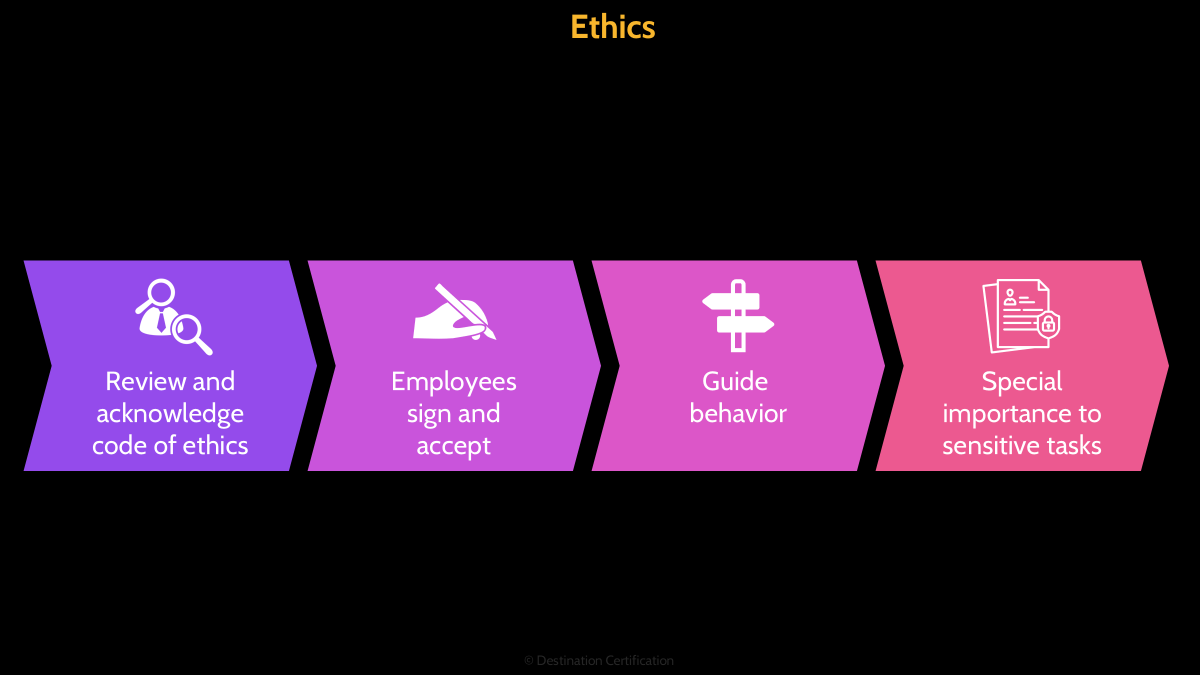
Clear roles and responsibilities create order, but structure without principles can still go astray. That’s why ethics are essential to guide behavior and decisions and they will be the last major piece we’ll be talking about in this video.
Ethics establish moral principles and standards that guide professional behavior and decision-making within the organization.
Do nothing harmful
The fundamental ethical principle of doing no harm requires professionals to consider the broader impact of their actions on stakeholders, systems, and society. This means actively preventing damage through careful planning, risk assessment, and choosing courses of action that protect rather than endanger. It extends beyond avoiding obvious harm to considering unintended consequences and long-term effects of decisions.
Review and acknowledge code of ethics
Regular review and acknowledgment of ethical codes ensures professionals remain aware of their obligations and standards of conduct. This process goes beyond mere compliance - it reinforces ethical thinking in daily decision-making and creates accountability for behavior.
Guide behaviour
Ethical principles serve as behavioral compass points, helping professionals navigate complex situations where rules may be unclear or conflicting. Policies may change, but principles are the North Star. They help professionals navigate gray areas without losing integrity — or the trust of others.

And that is an overview of Organizational Structure, Roles & Responsibilities within Domain 1, covering the most critical concepts you need to know for the exam.
Something really cool we are providing with these MindMap videos is a completely FREE downloadable version of all the MindMaps in PDF format. We even include a blank version of each MindMap in case you want to print them out and take notes as you listen along. Link to download the MindMaps is in the description below.
If you found this video helpful you can hit the thumbs up button and if you want to be notified when we release additional videos in this MindMap series, then please subscribe and hit the bell icon to get notifications.
I will provide links to the other MindMap videos in the description below.
Thanks very much for watching! And all the best in your studies