
CISM Domain 3 - Security Program Constraints and Challenges MindMap
Download FREE Audio Files and Printable PDFs of our MindMaps
Your information will remain 100% private. Unsubscribe with 1 click.
Transcript
Introduction
Hey, I’m Nick from Destination Certification, and I’m here to help YOU pass the CISM exam.
In this video, we’re going to break down a full MindMap of some of the most important concepts in Security Program Constraints and Challenges from Domain 3— not just to help you memorize terms, but to really understand how they interconnect and why they matter.
This is the second of thirteen videos for domain 3. I have included links to the other MindMap videos in the description below. These MindMaps are one part of our complete CISM MasterClass.
Constraints
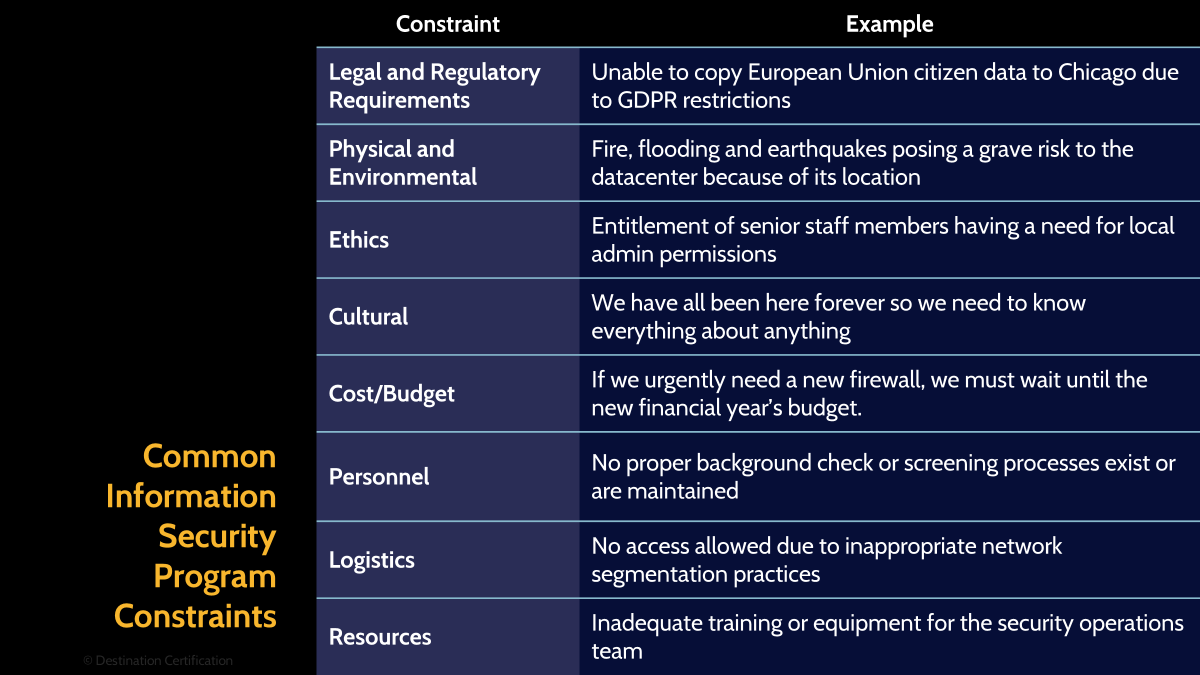
Just to give a bit of context, every security program operates within a complex ecosystem of limitations and obstacles that shape how we protect organizational assets. Understanding these constraints and challenges isn't just about recognizing problems—it's about developing strategic approaches to navigate them effectively.
Keeping that in mind, constraints represent the fixed boundaries within which security programs must operate—these are the non-negotiable realities that shape every decision we make. Unlike challenges that we might overcome with effort or resources, constraints are environmental factors we must accept and work within. Smart security leaders recognize that fighting constraints wastes valuable energy; instead, they design programs that leverage these boundaries as structural elements. Think of constraints as the walls of a building—you can't move them, but you can use them to support your security architecture in creative and effective ways.
Let’s talk through major security program constraints:
Legal/Regulatory
Legal and regulatory requirements form the backbone of many security decisions, dictating not just what we must do, but often how we must do it. These constraints come from multiple sources—federal regulations, state laws, industry standards, and international frameworks—each with their own penalties for non-compliance. Organizations in healthcare face HIPAA requirements, financial institutions navigate SOX and PCI-DSS, while global companies juggle GDPR alongside regional privacy laws.
Environmental
Environmental constraints encompass the physical and operational realities of where and how your organization functions. A manufacturing facility faces different environmental constraints than a cloud-native startup—from physical security requirements in harsh industrial settings to bandwidth limitations in remote locations. Geographic distribution creates its own challenges, whether you're securing multiple office locations or supporting a fully remote workforce. These environmental factors directly influence which security controls are feasible and how they can be implemented effectively.
Ethics
Another major constraint can be ethics.
Ethical constraints guide security programs toward practices that align with organizational values and societal expectations, even when technically or legally permissible alternatives exist. These constraints often manifest in decisions about employee monitoring, data collection practices, and incident response procedures. An organization might technically be able to monitor every keystroke, but ethical considerations around employee privacy create boundaries. Similarly, vulnerability disclosure practices must balance security needs with responsible disclosure ethics, shaping how we interact with researchers and the broader security community.
Cultural
Cultural constraints reflect the deeply embedded organizational behaviors and beliefs that influence how security initiatives are received and implemented. A startup culture that values speed and innovation might resist traditional change management processes, while a conservative financial institution might struggle with agile security practices. International organizations face additional complexity when security practices acceptable in one region conflict with cultural norms in another.
Cost
They say money makes the world go round, so it should come as no surprise that costs can be a major constraint.
Cost constraints go beyond simple budget limitations to encompass the total economic impact of security decisions on the organization. Every security control carries both direct costs such as licenses, hardware, personnel and indirect costs through operational friction and reduced productivity. Great security isn’t about endless budgets, it’s about creativity — open-source hacks, automation magic, and control reshuffles that deliver the same defense for less.
Personnel
Personnel constraints reflect the human resource limitations that shape security program capabilities—not just headcount, but the skills, experience, and availability of team members. Beyond numbers, personnel constraints include skill gaps where existing staff lack expertise in emerging technologies or specialized areas like cloud security or incident response.
Logistics
Logistical constraints involve the practical challenges of implementing and maintaining security controls across complex organizational structures. Coordinating security updates across multiple time zones, managing equipment deployment to remote locations, or synchronizing security training for thousands of employees all present logistical hurdles. These constraints become particularly acute during incident response when rapid coordination across dispersed teams and systems is critical. Incident response is a race against the clock, and supply chain delays are like pulling a hamstring mid-sprint.
Resources
A final constraint we will be discussing is resources.
Resource constraints extend beyond money and people to include time, technology, and organizational attention—all finite commodities that security must compete for. Limited processing power might restrict encryption options, aging infrastructure might not support modern security tools, and competing business initiatives might claim executive attention needed for security governance. Time itself becomes a critical resource constraint, particularly when security teams must balance ongoing operations with project work and incident response.
Challenges
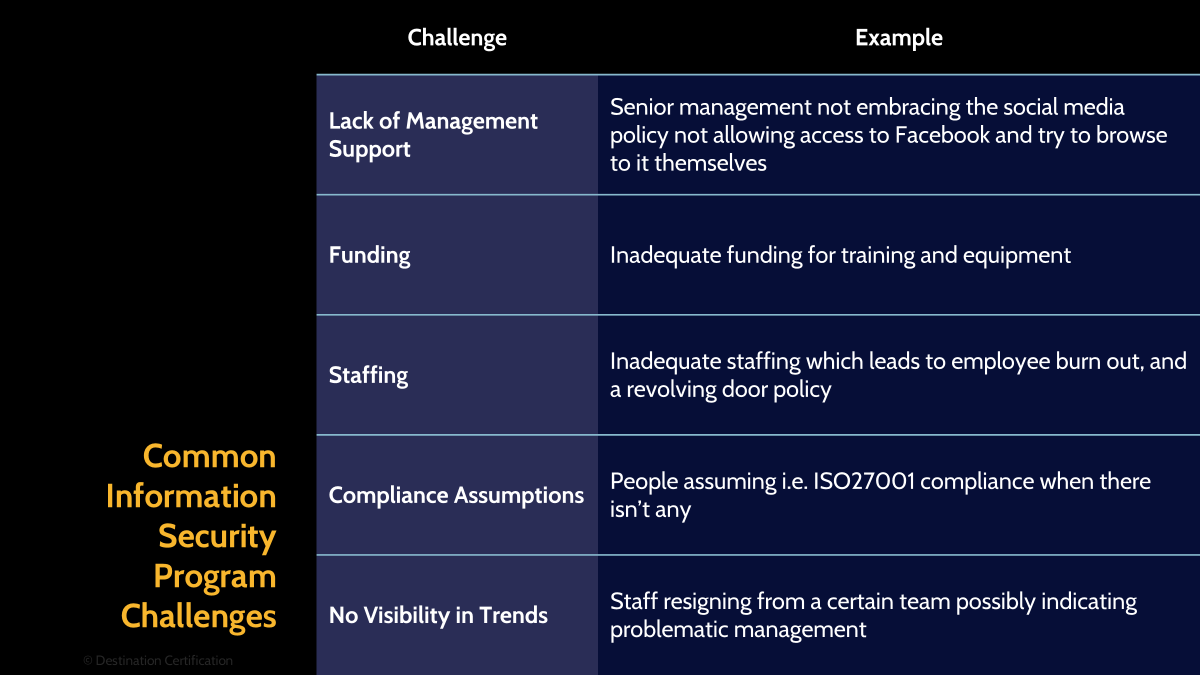
While constraints represent fixed boundaries, challenges are the dynamic obstacles that security programs must actively work to overcome.
These challenges often stem from organizational dynamics, market conditions, or evolving threat landscapes that create friction in security program execution. Unlike constraints that require adaptation, challenges demand active problem-solving and often represent opportunities for improvement. The most persistent challenges in security programs tend to be organizational rather than technical—rooted in misaligned incentives, communication gaps, and competing priorities that undermine security effectiveness even when technical solutions exist.
Lack of management support
Let’s talk about our first challenge and this one is pretty important: a lack of management support for security efforts.
When executive leadership views security as a cost center rather than a business enabler, security initiatives struggle to gain traction and resources. This challenge manifests in various ways—security recommendations ignored during project planning, incident response findings dismissed as overreactions, or security metrics absent from board reporting. Without management support, security teams find themselves constantly justifying their existence rather than improving security posture.
Funding
Another challenge is funding.
Funding challenges go beyond simple budget constraints to include the unpredictability and timing of financial resources for security initiatives. Security often struggles to demonstrate ROI in traditional financial terms, making it vulnerable to budget cuts during economic downturns. Trying to fund a multi-year security plan with one-year budgets is like building a skyscraper with a monthly allowance. This misalignment makes funding a major challenge.
Staffing
Next off, staffing challenges encompass not just hiring difficulties but the full lifecycle of building and maintaining an effective security team. High demand for security professionals drives salary inflation and aggressive recruiting that can destabilize existing teams. Once hired, retaining talented staff requires continuous investment in training, career development, and engaging work. The challenge compounds when organizations need specialized skills for short-term projects or struggle to provide 24/7 coverage with limited headcount.
Compliance assumptions
Organizations often conflate compliance with security, assuming that meeting regulatory requirements automatically results in adequate protection. This dangerous assumption leads to checkbox mentalities where teams focus on audit findings rather than actual risk reduction. Compliance frameworks are often the lowest bar set by committee — more politics than protection. If they drive your strategy, you’ll be guarding yesterday’s threats while tomorrow’s are already at the door.
No trending visibility
Our final challenge of this video is no trending visibility.
Without visibility into security trends and patterns, organizations operate blindly, unable to distinguish between isolated incidents and systemic issues. This challenge stems from inadequate logging, disconnected security tools, and absence of analytics capabilities that could reveal important patterns. It’s like déjà vu for security: the same incident keeps popping up because no one’s tackled the root cause. Lack of trending visibility also handicaps strategic planning, making it impossible to demonstrate improvement or deterioration in security posture over time.

And that is an overview of Security Program Constraints and Challenges within Domain 3, covering the most critical concepts you need to know for the exam.
Something really cool we are providing with these MindMap videos is a completely FREE downloadable version of all the MindMaps in PDF format. We even include a blank version of each MindMap in case you want to print them out and take notes as you listen along. Link to download the MindMaps is in the description below.
If you found this video helpful you can hit the thumbs up button and if you want to be notified when we release additional videos in this MindMap series, then please subscribe and hit the bell icon to get notifications.
I will provide links to the other MindMap videos in the description below.
Thanks very much for watching! And all the best in your studies