
CCSP Domain 2 - AI/ML Data Protection MindMap
Download FREE Audio Files of all the MindMaps
and a FREE Printable PDF of all the MindMaps
Your information will remain 100% private. Unsubscribe with 1 click.
Transcript
Introduction
Hey, I’m Rob Witcher from Destination Certification, and I’m here to help you pass the CCSP exam. We are going to go through a review of the major topics related to AI/ML Data Protection in Domain 2, to understand how they interrelate, and to guide your studies.
This is the sixth of five videos for Domain 2. I have included links to the other MindMap videos in the description below. These MindMaps are a small part of our complete CCSP MasterClass.
AI/ML Data Protection
An AI model is only as trustworthy as the data and pipelines behind it. The moment you feed a model sensitive information, you've created a brand-new attack surface that traditional security never had to worry about. The data, the model itself, and even the predictions the model makes can all leak secrets. So this raises a couple of questions. How do you protect data that has to be exposed to a model in order to be useful? And how do you keep individuals anonymous when that same model can be queried thousands of times?
Trustworthy AI starts with secure data, privacy protection, and responsible oversight.
It comes down to the principle that trustworthy AI starts with secure data, privacy protection, and responsible oversight. A brilliant model trained on stolen or leaked data is a liability waiting to happen. So, we need to spend a few minutes here talking about how we safeguard the privacy of the people in our data, the integrity of our model, and the security of the whole training-to-deployment lifecycle.
Dataset and Model Privacy
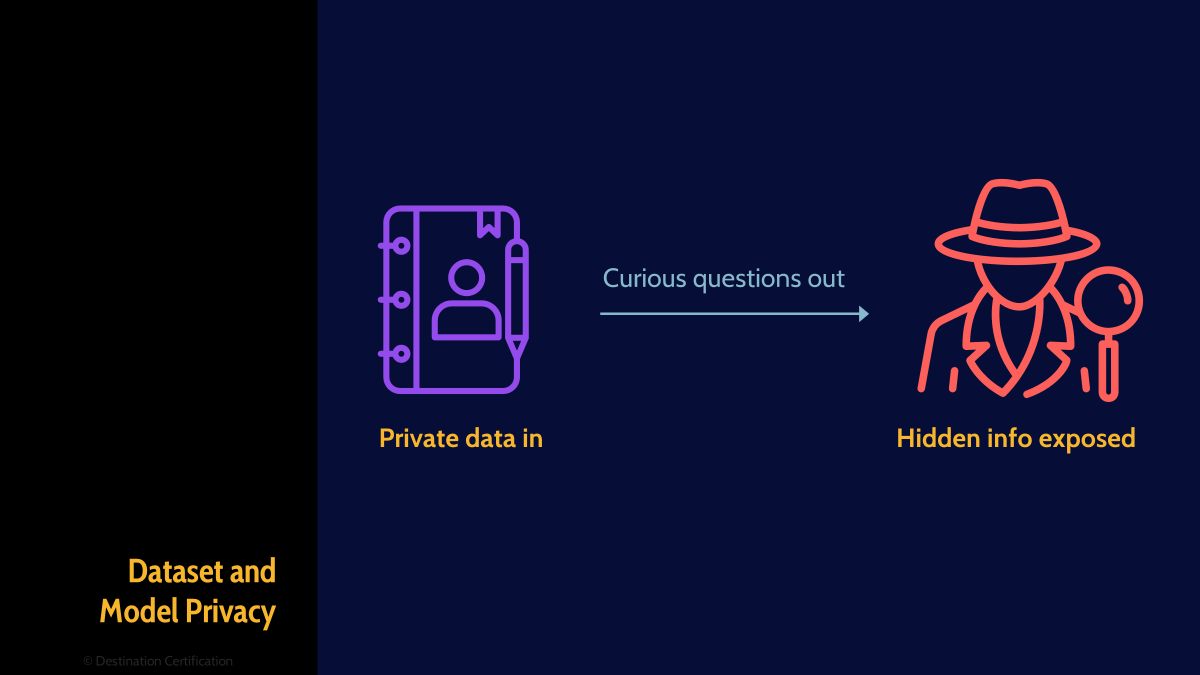
Let's start with dataset and model privacy. This is all about making sure your model doesn't accidentally memorize and reveal the personal information it was trained on.
Privacy-Preserving Techniques
In a typical healthcare or financial deployment that data is incredibly sensitive, so we lean on privacy-preserving techniques to defend against threats that try to extract or reconstruct it.
Differential Privacy
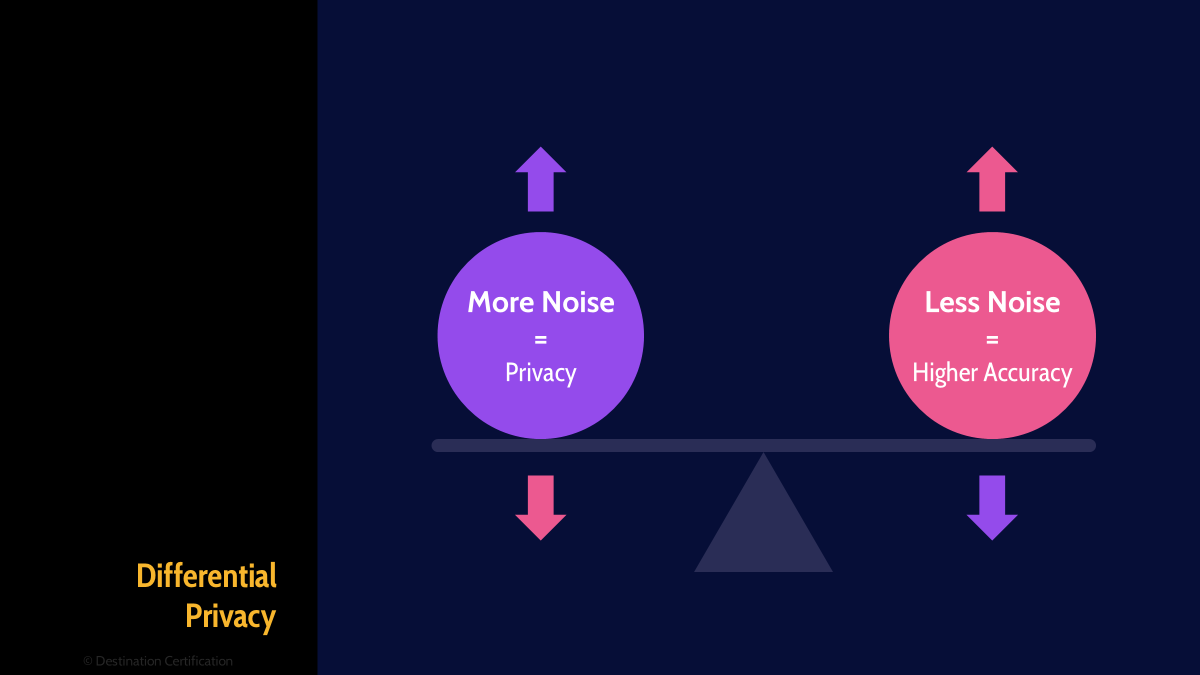
Let's start with differential privacy, which adds carefully calibrated mathematical noise so no single individual's data can be identified from the output.
Privacy-accuracy trade-off
But there's a catch, and it's the privacy-accuracy trade-off: more of this mathematical noise means stronger privacy but lower model accuracy, so you're always balancing the two.
Federated Learning
Next is federated learning, which trains models across many devices without the raw data ever leaving its source. Only the updates are shared.
Data Minimization
And then there's data minimization. Now, this one is worth pausing on, because it isn't really a fancy machine learning technique at all. It's one of the oldest principles in privacy: collect only the data you truly need. The logic is dead simple. Less data collected is less data to protect, and less data that could potentially leak. Data Minimization applies just as much to a paper form as it does to a neural network.
Privacy Threats
So those are the defenses. Now let's look over to the other side: privacy threats, the attacks that try to extract or expose the sensitive information hidden inside your trained model.
Model Inversion
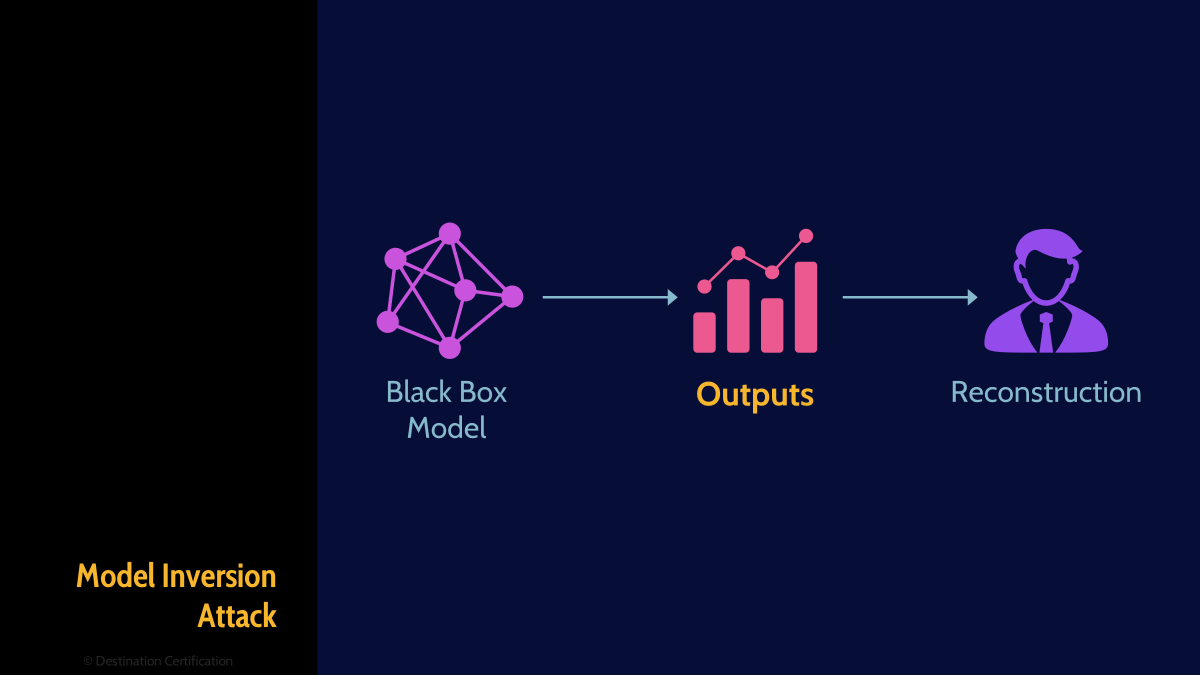
First, model inversion, where an attacker works backward from a model’s outputs to infer sensitive information about the data it was trained on. For example, if a model predicts someone’s medical risk, repeated queries might help an attacker infer private attributes about that person or reconstruct patterns from the training data.
Data leakage
Second, data leakage, where private, protected, or otherwise inappropriate information unintentionally gets exposed through the AI system. This might happen because sensitive data was included in the training set, because the model memorized parts of that data, or because private information accidentally appears in the model’s outputs.
Because data leakage and model inversion are similar, here’s a simple way to distinguish them: Model inversion is an attack technique. Whereas, Data leakage is an exposure problem.
Dataset and Model Security
After our threats, let’s review dataset and model security. Where privacy protects the people in your data, security protects the assets themselves, the data and the model, from tampering and theft.
Dual Attack Surface
Before we move on to anything else, remember that attackers can target two things: your training data and your model artifacts.
Training data
The first is training data, the dataset that shapes your model. Poison it, and you can corrupt everything the model learns.
Model artifacts
The second is model artifacts, the trained files, the weights and parameters, that attackers may steal, tamper with, or replace.
Build-Time Controls
So how do we defend these attack surfaces? It starts with build-time controls, the safeguards you apply during development to keep the training pipeline trustworthy.
Supply Chain Security
The first is supply chain security, verifying that your datasets, libraries, and pre-trained models all come from trusted, untampered sources.
Model Integrity and Signing
The 2nd involves cryptographic services and digital signatures. We’ll unpack this in a separate MindMap as it’s a HUGE topic, when we get to Domain 4.
Pre-Deployment Assurance
Once the model has been developed, we move to pre-deployment assurance, the testing and validation you perform to confirm a model is safe before it ever goes live.
Adversarial Robustness Testing
The key technique here is adversarial robustness testing, which probes your model with crafted malicious inputs to see how easily it can be fooled. You are throwing the same sort of malicious inputs at your model that an attacker would.
Runtime Controls
And the final major topic here: Runtime controls. Once the model is deployed live, runtime controls are the protections active in production, defending the model during real-world use.
Access Controls
Access Controls limit who can query, modify, or extract your model. We talk about access controls in a bunch of detail in Domain 4.
Incident Response
Second, Incident Response is your planned playbook for detecting, containing, and recovering from an attack on your model. We’ll talk about incident response in much more detail in Domain 5.
Continuous Model Monitoring
And third, continuous model monitoring. One thing to keep in mind is that an AI model really isn't a "set it and forget it" asset. A model is a lot like a toddler. The second you turn your back, it's going to start eating rocks or smearing paint all over your walls. So continuous monitoring keeps a constant eye on model behavior in production, catching problems, degradation, and attacks as they emerge rather than months later when the damage is done.
Model drift
And the big one to monitor for is model drift. This is when a model's accuracy quietly degrades over time because the real-world data has shifted away from what the model was trained on. Picture a fraud detection model trained on last year's patterns: attackers change their tactics, customer behavior changes, and slowly the model is making decisions about a world that no longer exists. Nothing broke, nobody attacked it, but it's drifting out of step with reality, which is exactly why we monitor closely for model drift.
Metrics
To catch drift and other issues, we need to define and track good metrics, the measurable signals that tell us whether a model is performing healthily in production. Here are a couple to look out for:
Prediction confidence distribution
First, the prediction confidence distribution, which shows how sure the model is across its outputs. Sudden shifts can signal trouble or an attack.
Error rate
Second, the error rate, the proportion of incorrect predictions. A rising error rate is an early warning of degradation or tampering.
FP rate
Third, the FP rate, or false positive rate, which measures how often the model flags something as positive when it actually isn't.
FN rate
And fourth, the FN rate, or false negative rate, which measures how often the model misses the true positives it should have caught. And this is often the one that hurts most in security: a false positive wastes an analyst's time, but a false negative is the attack that sailed straight through undetected. So something bad is happening and an alert isn’t raised. Very bad.

If you found this video helpful you can hit the thumbs up button and if you want to be notified when we release additional videos in this MindMap series, then please subscribe and hit the bell icon to get notifications.
I will provide links to the other MindMap videos in the description below.
Thanks very much for watching! And all the best in your studies!